After the Hype: Conflux’s Dan Woodford on What It Takes to Scale Aerospace AM – 3DPrint.com
 Varun
Varun
A decade ago, Conflux Technology was founded around a simple idea: heat exchangers might be one of the best applications for metal additive manufacturing (AM).
At the time, much of the industry was focused on what 3D printing would someday achieve. Conflux took a different approach, spending years developing a technology it believed could eventually meet the demanding requirements of aerospace, defense, and motorsport. Today, according to CEO Dan Woodford, that long-term bet is beginning to pay off.
“The momentum that people talked about five or ten years ago is now actually there,” Woodford told 3DPrint.com. “The intention is converting into action.”
Dan Woodford, Conflux Technologies CEO.

The Australian company specializes in additively manufactured metal heat exchangers, where better performance can justify higher costs. After nearly a decade of developing the technology and working with customers, Conflux now finds itself operating in a market shifting from experimentation to real deployment.
“The fact that additive is becoming a serious part of the design and creation of next-generation aircraft is now just a fact. It’s moved from being something people thought might be useful to something that is deliberately being included in development programs. The momentum that people talked about five or ten years ago is now actually there. Does that mean we’re suddenly going to see huge numbers of parts flying tomorrow? No. But the intention is converting into action.”
That change is visible across aerospace programs where AM is being considered from the beginning, rather than added later as an experiment.
The idea came from founder Michael Fuller, who spent years working in Formula One before launching Conflux in 2015. He saw heat exchangers as one of the applications where metal 3D printing could offer a clear advantage over traditional manufacturing. The complex internal channels, large surface areas, and demanding cooling requirements involved in thermal management made them a great fit. Rather than trying to apply AM everywhere, the company focused on a single challenge.
“We gave ourselves a head start and chose a really difficult subject matter,” said Woodford. “When we started, the technology was still maturing, but now we’re in a really good position. A lot of companies are using additive in interesting ways, often alongside traditional manufacturing. What we’re seeing now is that entire heat exchangers are increasingly being built through additive manufacturing, and that’s becoming much more common.”
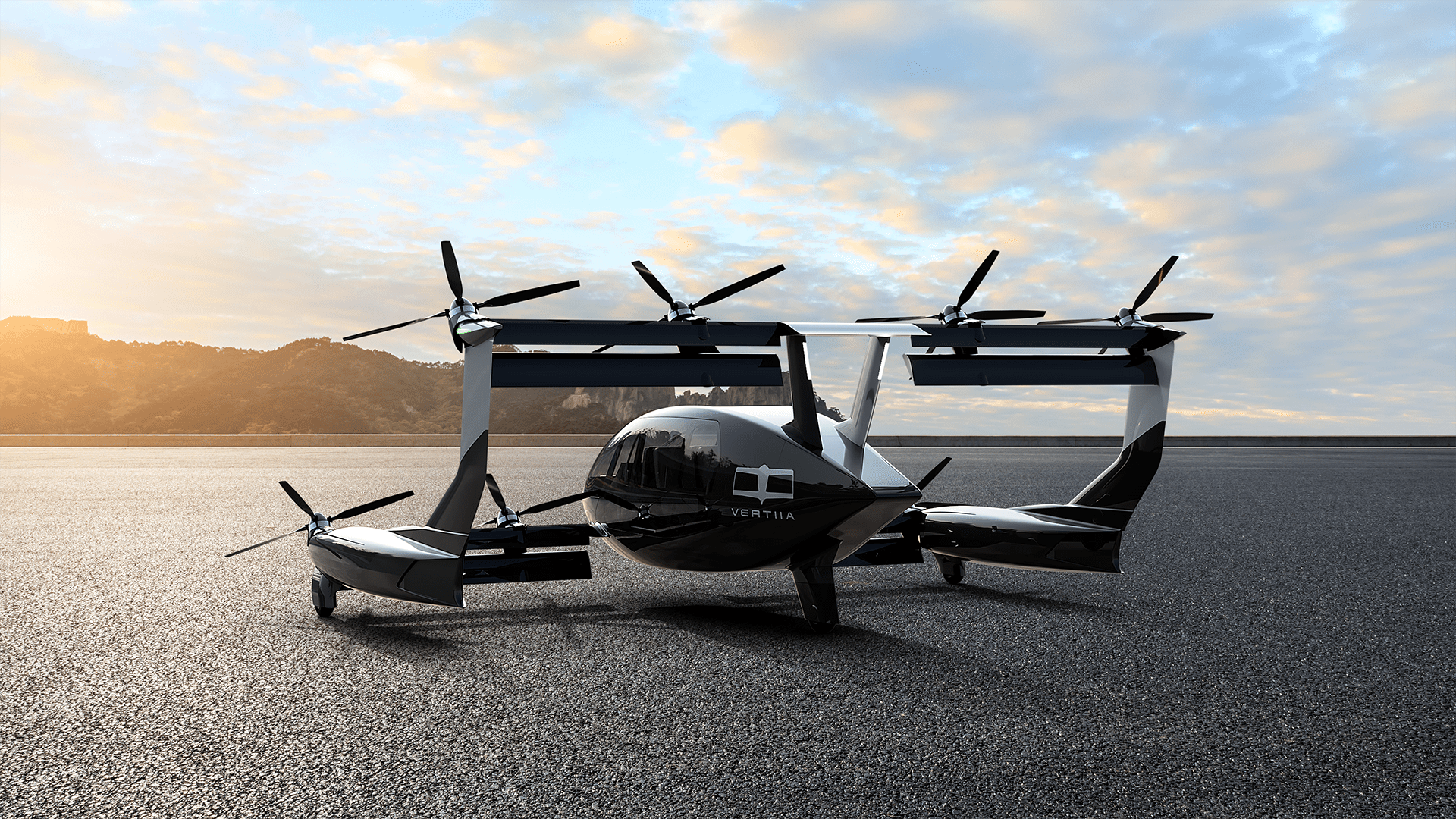
AMSL Aero’s Vertiia aims to be the world’s most efficient long-range, zero-emissions, electric VTOL aircraft. Image courtesy of Conflux.
Today, aerospace and defense have become one of the company’s major growth areas. In fact, Conflux has worked with aerospace customers since 2018 and has participated in programs involving organizations such as Airbus, Honeywell, and General Atomics. Among its public projects are contributions to hydrogen-powered aircraft development, including Airbus’ zero-emission initiatives and the European Union-funded THEMEA4HERA program, which focuses on thermal management systems for future hydrogen regional aircraft.
For Woodford, however, the bigger story is not any single project. It is the industry’s growing focus on certification.
“The second thing that’s changed is that companies are now taking certification seriously and translating it into concrete action. For us, that’s both a challenge and an opportunity. The conversation has shifted from whether additive can do the job to how we qualify it, how we certify it, and how we put it into service.”
But getting AM into aerospace isn’t simply a matter of buying bigger printers or faster machines. According to Woodford, the challenge is much broader than that: “People sometimes think scaling means buying more machines, but that’s only one piece of the puzzle. It’s an entire production system. You need the right designs, the ability to manufacture consistently, depowdering, post-processing, inspection, and quality systems. It’s an end-to-end production process. That’s what scaling actually looks like.”
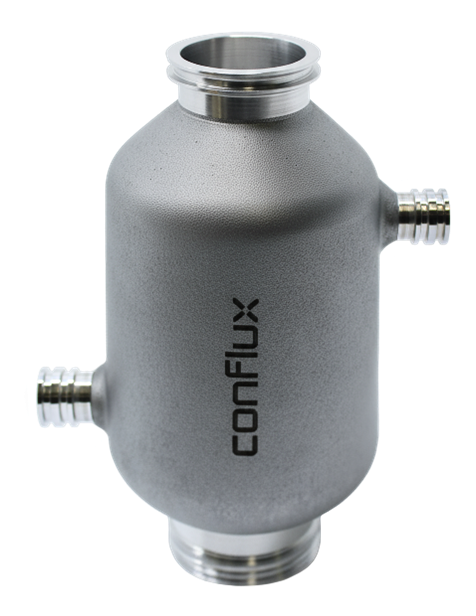
Advanced liquid-liquid heat exchanger. Image courtesy of Conflux.
Conflux is already producing hundreds of heat exchangers annually for customers outside aerospace, primarily in automotive applications. The company’s long-term goal is to reach production volumes in the thousands while creating manufacturing systems that can be replicated beyond its own facilities.
Size is another challenge. Many of the heat exchangers being developed for aircraft are larger than what today’s metal 3D printers can produce in a single build. To get around that limitation, Conflux has developed designs that allow multiple printed sections to be joined into a single component.
“A lot of the aerospace parts we’re creating today are actually larger than the machines can print in one piece,” Woodford explained. “We’ve developed ways to create modular parts made up of two, three, or more sections that are joined together into a single component. We’ve already deployed those into aviation test programs, and we’re progressing that approach. Longer term, large-format machines will become important because that’s where you really unlock the maximum performance.”
While commercial aerospace remains a long-term opportunity, defense programs and newer aircraft projects are moving faster. Conflux is already working with advanced air mobility companies and sees drones and other uncrewed aircraft as a way to get parts into service sooner. In many cases, the approval process is less demanding than it is for large passenger aircraft.
“We are already crossing into production,” he noted. “The reality is that commercial aviation moves deliberately. Putting a part onto an aircraft that carries thousands of passengers will always take time. There are hurdles we need to clear, and we’re working through them with our partners. Some things simply can’t be accelerated.”
One thing Woodford would like more people to understand is that AM is no longer a technology of the future.
“I’d like more engineers to realize that additive is ready to be included in product development roadmaps and taken seriously. There are still hurdles, especially in aerospace certification, but those hurdles are being addressed. That’s the exciting part. The technology isn’t waiting for a future opportunity anymore. The opportunity is already here,” concluded Woodford.
Subscribe to Our Email Newsletter
Stay up-to-date on all the latest news from the 3D printing industry and receive information and offers from third party vendors.
Upload your 3D Models and get them printed quickly and efficiently.