The Hidden Economics of Metal 3D Printing: Closing the Loop in Powder Management – 3DPrint.com
 Varun
Varun
Automation is a very topical thing in additive manufacturing at the moment. With renewed scale, some clients are fervently looking to automate production. Other business cases only make sense with improved conveyancing. In things like depowdering, resurfacing, sieving, and machine turnaround, processes like LPBF can be significantly improved. Improvements in yield, surface, and repeatability, along with cost per part reductions, really matter in 3D printing today.
But the automation companies actually helping firms improve the economics of additive manufacturing are less well known. That’s why we wanted to look into a key player, Ossberger. The 150-year-old engineering firm started in fluid mechanics and now makes plastics processing equipment, industrial cleaning solutions, and powder management for additive manufacturing. We interviewed Markus Garscha, who is Ossberger’s Additive Manufacturing Business Unit Director. Markus has been with Ossberger for 13 years, including 10 in additive. Before that, Markus worked at precision manufacturing firm Liebherr and Fraunhofer IIS.
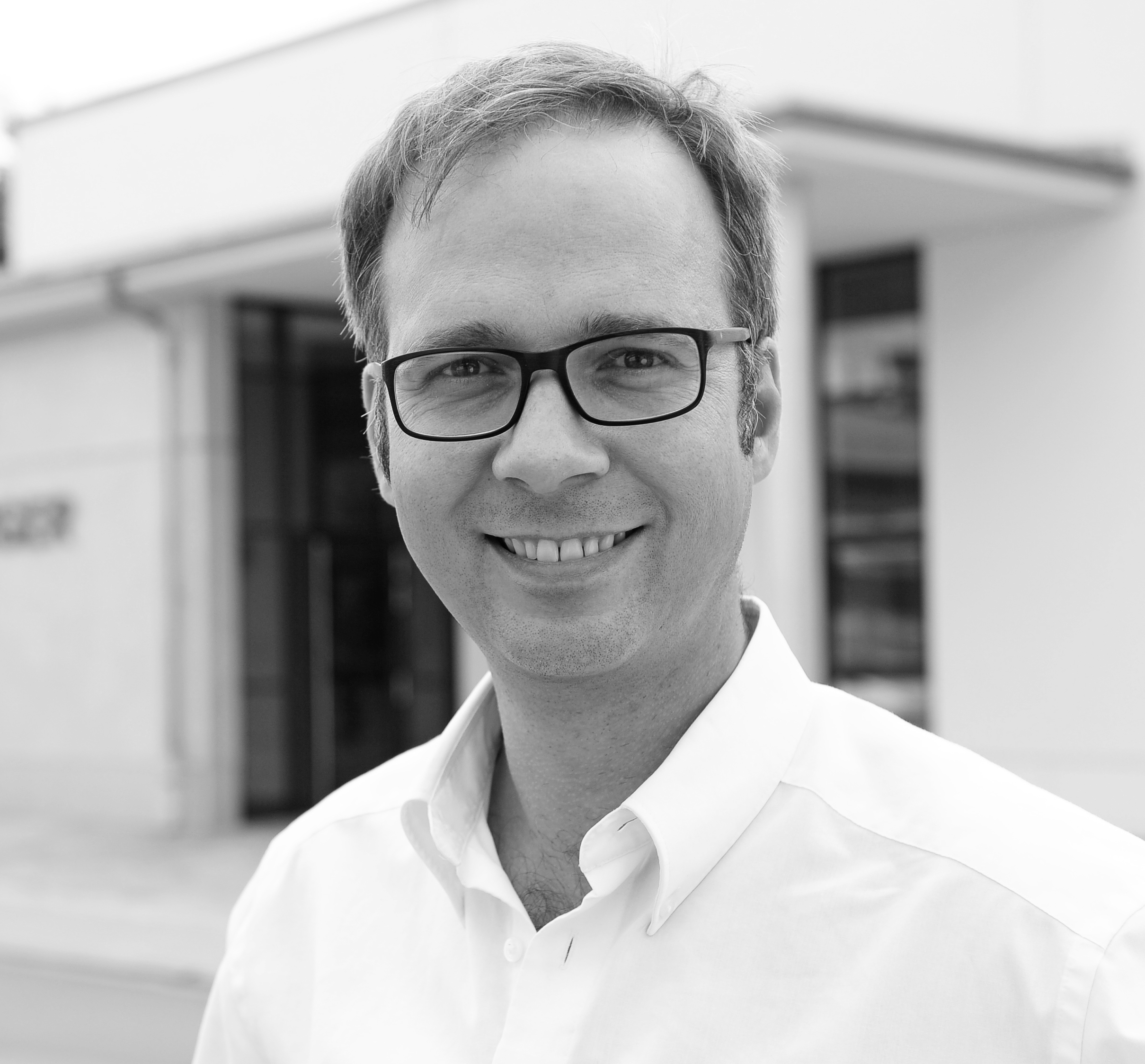
Markus Garscha. Image courtesy of Ossberger
Ossberger got into additive because it started using the technology to make flow nozzles for its cleaning solutions. The company found that post-processing steps added cost, so it developed equipment to make its internal process more efficient. It then went to Formnext and, based on that response, entered the business as a vendor.
Ossberger is different in that its fluid mechanics focus means that “we sometimes solve problems quite differently from our competitors in the additive manufacturing industry.” Ossberger is focused on what happens after the LPBF job is finished. Powder preparation, powder management, and unpacking, in particular, with a focus on “process output.”
This means:
“At the end of our process chain, we want to deliver one of two things: ready-to-use powder directly back into the printer, or unpacked and separated parts that are ready for the next manufacturing step. So our focus is not simply on individual machines. We look at the complete workflow and how we can make it closed, reproducible and highly efficient.”
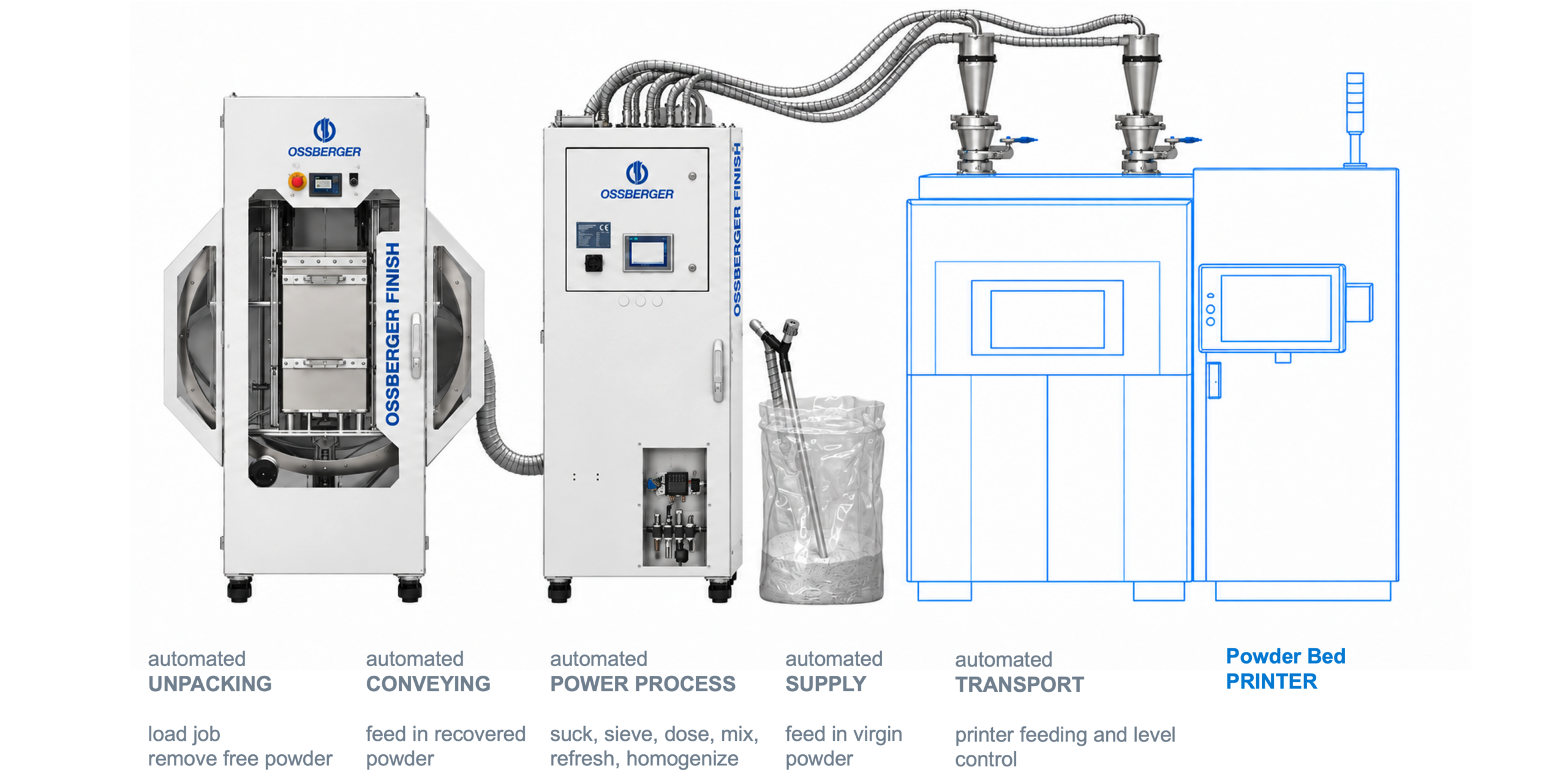
OSSBERGER’s automated powder handling and recovery system integrates unpacking, conveying, powder processing, material supply, and transport with a powder bed 3D printer. Image courtesy of Ossberger.
With a holistic process focus and a fluid-mechanics view, this seems like a healthy approach to the challenge. Rather than treating each step separately, examining the overall flow, condition, and utilization of powder could optimize the process as a whole.
It all seems sensible enough, but what exactly can I expect when I invest in unpacking? What money can I save?
“The most obvious saving is manual labor. But there is more to it. An automated unpacking process is significantly faster and, most importantly, reproducible. The quality of the recovered powder and the quality of the unpacked parts are determined by defined machine parameters rather than by the individual operator. So when you combine labor savings, higher throughput, process reliability and reproducibility, we typically see our customers achieving a payback period of around 6 to 18 months, depending on utilization, material and production environment.”
A super overlooked part of LPBF, in general, is sieving, which sounds like a kids-on-the-beach kind of thing. It also seems to be rather a low-value part of the entire thing. Markus disagrees.
“With sieving, the business case goes beyond simply reducing labor. The more important aspect is creating a controlled and reproducible powder loop. Especially with high-value powders, the material itself represents a significant cost. The more reliably we can recover, prepare and return that powder to the printing process, the better the economics of the entire Additive Manufacturing process become. So the value is not just in the sieving process. It is in keeping valuable powder in a controlled production loop.”
Powder loss throughout the process can affect buy-to-fly ratios and overall powder costs. Consistent reductions in this loss add up, but beyond material costs, sieving can also affect quality.
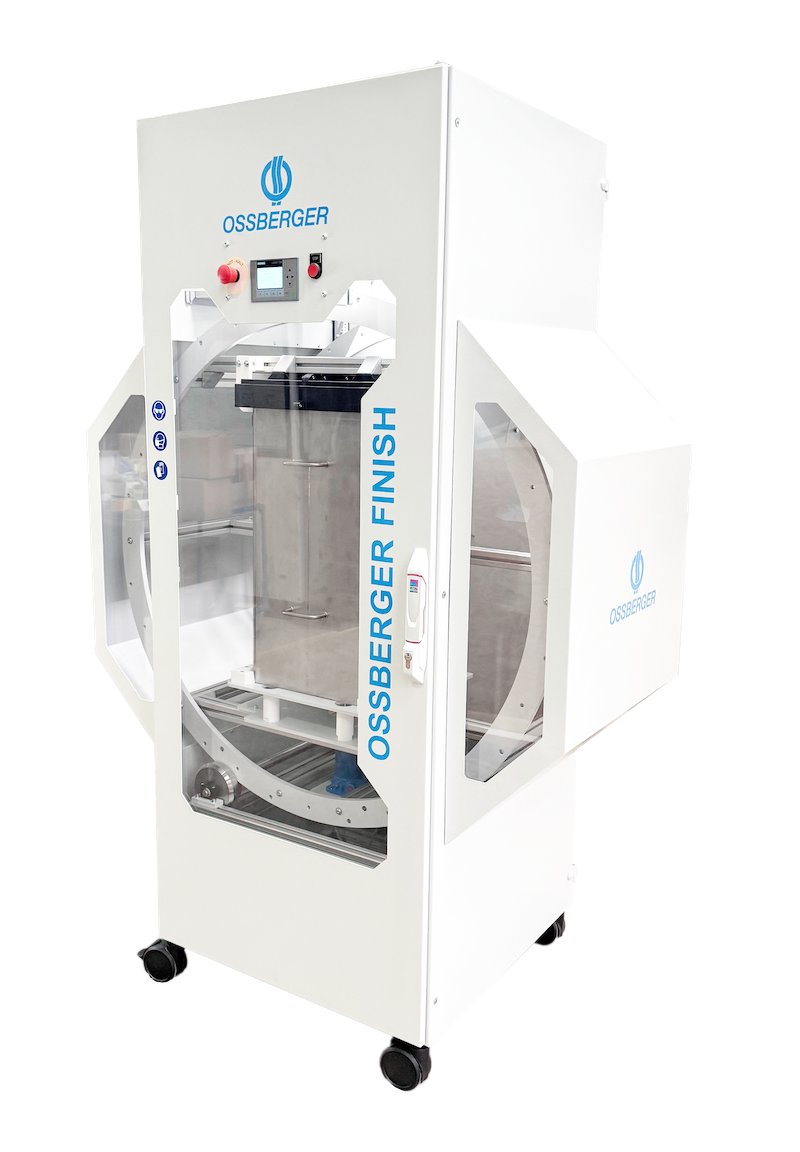
Ossberger Finish automated unpacking system for powder bed 3D printing. Image courtesy of Ossberger.
Markus thinks that “sieving – and powder preparation in general – is often underestimated. One of the main reasons is that you cannot directly see the quality of the powder or the quality of the powder-handling process. You usually only see the consequences when something goes wrong – through quality issues in the parts or, in the worst case, a failed build job. There is also another aspect: the industry has traditionally focused much more on supplying new powder than on helping users maximize the lifetime and reuse of the powder they already have. Naturally, if your business is selling virgin powder, there is less incentive to show customers how effective powder management can significantly reduce their consumption of new material. That is why a reproducible powder process is so important.
“When processing reused powder, we need to maintain defined and reproducible material properties such as particle-size distribution over multiple reuse cycles. Mixing is also more complex than it appears. You cannot introduce too much energy into the material, while at the same time you have to prevent segregation. And it goes beyond sieving. Homogenizing, conveying, storing and returning the powder are all important elements of a stable closed-loop process. For us, the goal is simple: use as little virgin powder as necessary and keep as much valuable material as possible in a controlled, repeatable production loop.”
To me, one of the most exciting new developments in LPBF is in the $50,000 to $200,000 machine segment where entry-level production solutions are being offered. This segment, to me, will be a major growth driver for additive in the future. A lot of companies can now easily buy an LPBF system that can make actual parts for them. Ossberger will address this market segment.
“Especially for start-ups and smaller users, flexibility and cost efficiency are extremely important. They don’t have the time and money to waste. That is why we have developed what I like to call “Swiss Army knife” solutions: compact, flexible systems that can combine several functions. For a company entering additive manufacturing, this can significantly reduce both the initial investment and the amount of time and labor required in daily operation.”
Ossberger’s approach is to offer solutions that can scale with production volume. Ossberger sells individual modules that you can pick and choose from or replace. The company thinks that this flexible approach will serve customers in competitive markets well. You could start with one entry-level module and expand it into something that caters to many printers. Automatic unpacking is manual, while the powder loop is automated. One thing that I really want to see is more hot unpacking, which can really shave a lot of time off the part and help people make more money. Ossberger now handles hot build jobs, but Markus thinks that “the question is when it makes sense from both a process and an economic perspective.”
“That depends heavily on the physics of the individual job — the packing density, part geometries, material, build height and temperature. Interestingly, we currently see this requirement more often in service provider environments than in traditional industrial series production, because for service providers or prototype parts every hour of lead time can be important. So we do not look at hot unpacking as a goal in itself. We always look at whether it improves the overall process chain.”
A lot of people now are looking more at better machine utilization. People are looking at finishing, pushing out, and continuing builds at night or on the weekend.
Markus sees a lot of value here.
“One possible workflow, for example, is to load a still-warm build job into the system in the evening, allow it to cool down in a controlled environment overnight, and automatically start the process shortly before the morning shift begins. Interestingly, our unpacking process itself is already very fast. In many cases, it makes more sense to start unpacking in the morning because within just a few minutes we can provide the unpacked parts, while the subsequent process steps often take significantly longer. So the real question is not necessarily, ‘Can I run this machine all night?’ It is, ‘How can I optimize the timing of my entire process chain?’”
My dream has always been “hot unpack to resurfacing” in one machine. That would save space in retail environments or for people with plants where floor space is expensive, while reducing manual labor. Would that be possible?
“Technically, yes. We have already tested concepts like this internally, including alternative technologies that avoid blasting with potentially contaminating media. Today, however, the key question is economics. There are still relatively few customers with enough production volume to justify a fully integrated system covering everything from unpacking through surface processing.
“There is also an important technical consideration. Unpacking has relatively little influence on the final surface quality of the part. Abrasive or densifying processes, on the other hand, can have a much greater impact on the final component quality or scrap rate. With mixed jobs containing different part geometries, you therefore often need to sort the parts or individually parameterize the abrasive or following process.
“The situation is different in industrial series applications – for example eyewear, drone components or dental parts. There you have more homogeneous jobs and higher volumes, which makes fully integrated solutions much more interesting.”
Markus thinks that the state of the art right now is closed-loop powder management and scalable solutions. For Ossberger, keeping this in mind while wasting less and making the customer’s life easier are key considerations. As the industry grows, the importance of sieving and powder management will become clearer. At the same time, more time saved and greater consistency will enable more parts. Add the expected growth in the entry-level segment, and Ossberger could see considerable growth ahead.
Subscribe to Our Email Newsletter
Stay up-to-date on all the latest news from the 3D printing industry and receive information and offers from third party vendors.
Upload your 3D Models and get them printed quickly and efficiently.