 Varun
Additionally, Paez and her team are exploring robotic spraying, where bacteria, sand, urea, and calcium chloride are sprayed layer by layer. The team showcased this at the 2025 Biennale Architettura in Venice for six months. This automated approach could be a promising path toward bacteria-3D printed buildings. Some things will have to be fixed, of course, like safely capturing the ammonia so it isn’t absorbed into the soil. Calcium chloride is also a respiratory irritant, so you probably will want to do this in a central factory or enclosure of some sort while wearing PPE. Happily, the team is looking to mitigate any environmental risks.
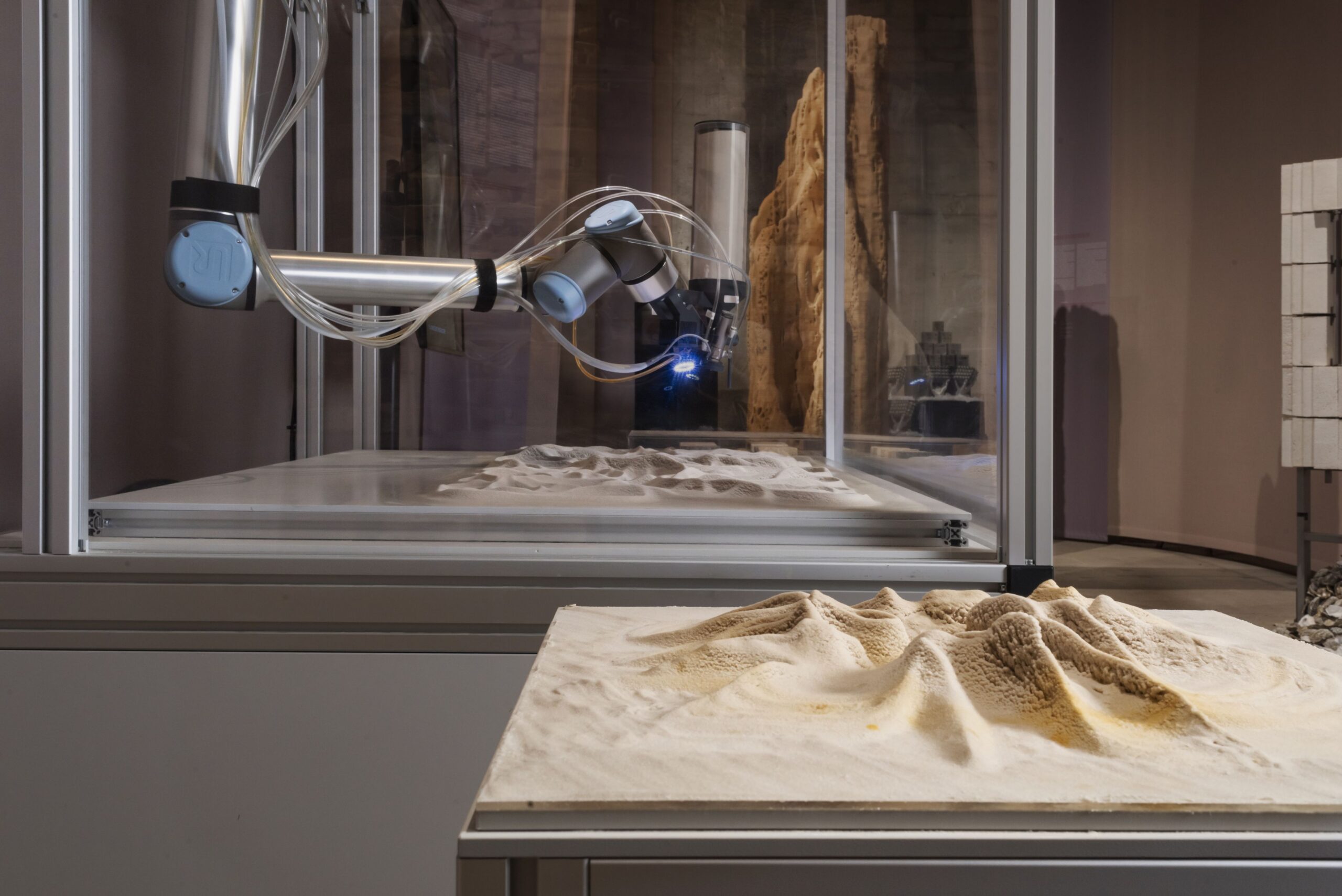
A robotic spraying system used to create biocement structures with bacteria. Image courtesy of ETH Zurich/Matteo Losurdo.
Paez considers that “The printing is geared more towards architectural elements, while the spray process is more designed for surfaces.”
For the spray process, mechanical properties, bonding, and deposition remain challenges. Paez also states that while facades and the like are doable, actually getting the binder, aggregate, proportions, and recipe right may take a very long time. You can find this research in 3D biocement printing: scaling up living mineral structure, robotic biocementation spraying: a bioinspired fabrication method for architectural surfaces, and design workflow for porous 3D printed biocement geometries.
In situ SEM imagery of Bacteria building structures.
I love this so much. This is a completely new way of making structures, but at the same time it’s analogous to some of the oldest ways of making. Things like coral and stalactites are very similar. Bacteria already manufacture so much for us, from insulin to antibiotics, vaccines, bioplastics such as PHA, yogurt, and kimchi. This could be a super-sustainable process that produces certain architectural elements that are recyclable and use little energy. If the team can find a way to turn excess ammonia into fertilizer on site, or perhaps use the nylon rope trick invented by Stephanie Kwolek, who invented Kevlar, you could make PA66 or something else useful with the excess ammonia. We don’t yet know whether this process is feasible for construction or what the costs would be. But if you’re an artist, designer, municipality, or science museum that wishes to showcase a world radically different from our own, then this may be just the ticket. Bacteria already build so much for us; why not buildings?