Is AI the Next Big Shift in AM? RAPID + TCT 2026 Takes a Closer Look – 3DPrint.com
 Varun
Varun
There’s a moment in every technology shift when something clicks.
Suddenly, the tools that once felt like experiments start solving real problems. The separate breakthroughs begin to connect. And what looked like a few interesting ideas starts to feel like the early stages of something bigger. That’s where additive manufacturing (AM) and artificial intelligence (AI) are right now.
For years, AI has hovered around the edges of AM. Researchers have used it to analyze melt pool behavior during printing. Engineers have experimented with it to optimize designs for additive processes. And software teams have explored machine-learning models to detect defects or improve simulations.
Plenty of important work, but often happening separately. Now those pieces are starting to connect.
AI is moving beyond individual experiments and becoming something much larger: a framework for how AM systems design parts, monitor processes, predict outcomes, and even improve themselves. And if you want to see how fast that shift is happening, one of the best places to look is RAPID + TCT 2026.

Materialise CEO Brigitte de Vet-Veithen speaking at RAPID + TCT.
The Moment AI Moves From Tool to Production
Most people still think about AI in manufacturing as a feature. For example, a design tool might suggest a better geometry. Or a monitoring system might detect a defect earlier. Or a simulation program might run faster. It’s all very useful, for sure. But they’re still small improvements.
The idea that AI could move beyond individual tools and start shaping the entire AM workflow is being discussed across the industry by companies and researchers alike. Instead of solving just one problem at a time, AI could begin to connect different parts of the process. Design ideas can be tested in a simulation. The results help guide how the part is printed. The printer then collects data during the build. And that data helps make the next build better.
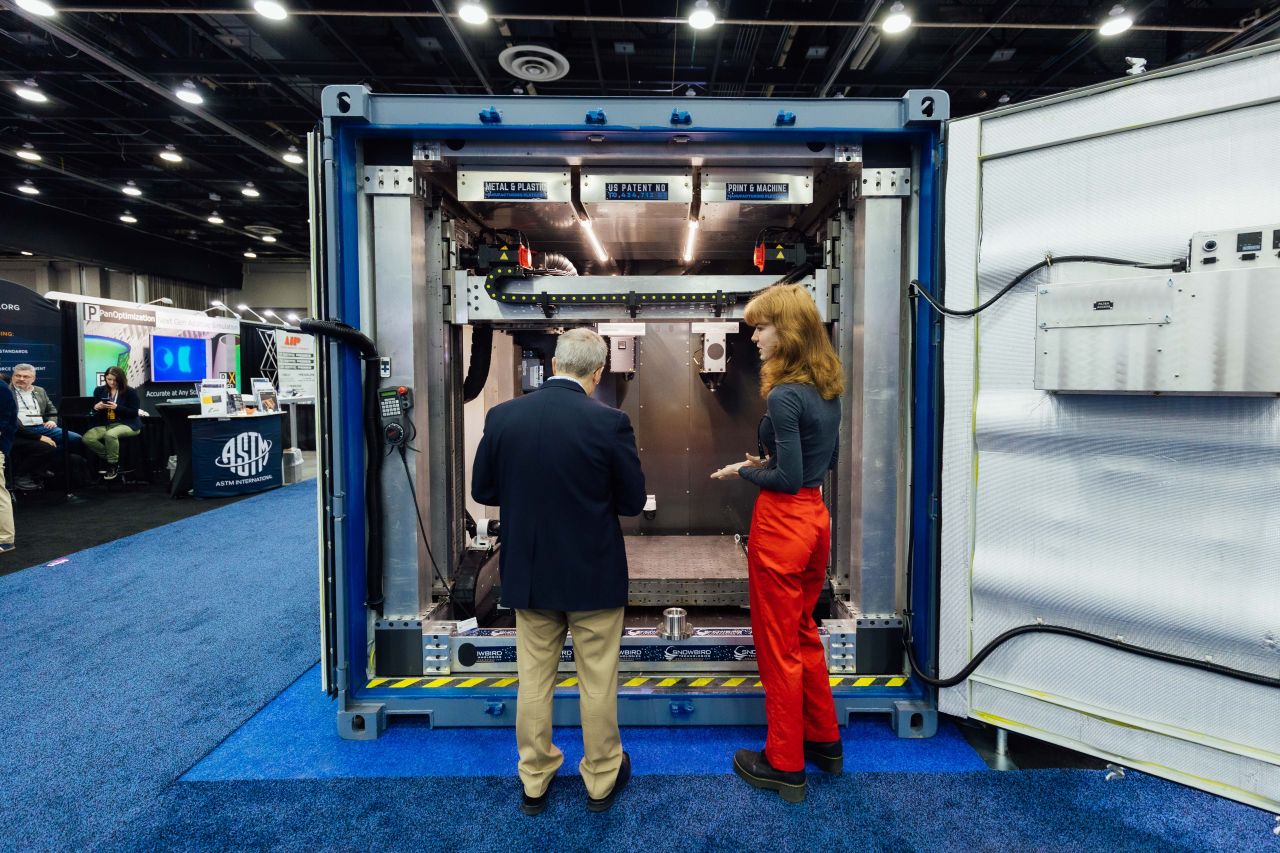
That process (design, print, analyze, improve) is one reason AM is starting to look very different from traditional manufacturing. And it’s exactly the kind of conversation happening at RAPID + TCT 2026.
The RAPID + TCT 2026 conference program, taking place April 8–10 in Detroit, includes ten sessions focused on artificial intelligence in AM, covering everything from design and simulation to production monitoring and workflow automation.
Some sessions explore how AI can help engineers design better parts for AM. For example, Autodesk will discuss how AI and advanced modeling techniques are helping improve product design, while Siemens will look at the future of AM through the combined lens of design, simulation, and AI.
Others focus on the production process itself. Researchers from Rowan University will present work on using AI to predict melt pool depth and keyhole formation in metal laser powder bed fusion, while Western Michigan University will explore how machine learning can help optimize hybrid metal printing systems.
There are also sessions examining how AI could help manage complex manufacturing workflows. Synera Technologies will discuss agentic AI and intelligent workflow automation for AM, while the Advanced Structures and Composite Center will present work on integrating AI into closed-loop, traceable production systems.
And for industries where reliability is critical, companies like EOS and Lockheed Martin will explore how AI can help qualify mission-critical components and investigate root causes when problems occur.
The Next Chapter of AM
For decades, AM has been defined by its machines. First, better printers, then new materials and improved process parameters. Those things still matter, of course. But we are also seeing that some of the biggest breakthroughs are happening in the digital layer around those machines.
Design tools are becoming smarter. Simulations are becoming much more predictive. Production systems are becoming more adaptive. And AI is beginning to connect all of it.
Could the result be something bigger than faster printing or better parts? Maybe it’s the beginning of manufacturing systems that learn, adapt, and improve with every build. What’s interesting is that this future isn’t decades away. It’s already beginning to take shape. And for anyone trying to understand how AI may reshape additive manufacturing, RAPID + TCT 2026 is one of the best places to see it happening in real time.
For years, the conference has brought together engineers, researchers, software developers, and industry leaders to share what’s working and what’s next. This year, AI is one of the threads connecting many of the conversations across the AM industry.
Images courtesy of RAPID + TCT
Subscribe to Our Email Newsletter
Stay up-to-date on all the latest news from the 3D printing industry and receive information and offers from third party vendors.
Upload your 3D Models and get them printed quickly and efficiently.