AM Applications Expected to Reach $110B in 2034, New Report Finds – 3DPrint.com
 Varun
Varun
Additive manufacturing may still be a relatively young industry, but the number of real parts being produced with 3D printing is growing quickly. According to a new report from Additive Manufacturing Research (AM Research), the value of parts produced with additive manufacturing could reach $110 billion by 2034, pointing to continued expansion of the technology across several industries.
The report, titled “AM Applications Analysis: Parts Produced 2025–2034,” looks at both the number of parts being produced and the overall market value those parts represent. It covers applications across eight major sectors and tracks both polymer and metal additive manufacturing. The data shows market activity through the end of 2025 and includes projections for the next decade.
Overall, AM Research estimates that additive manufacturing parts will account for about $24.5 billion in market impact in 2025, with steady growth expected through the coming years. By the early 2030s, the total value of printed parts is projected to exceed $100 billion annually, pointing to the expanding role of additive manufacturing in production. The report suggests that 3D printing is continuing to move beyond prototyping and into real manufacturing.
Aerospace Still Leads Metal AM Value
One industry where metal 3D printing continues to stand out is aerospace. According to AM Research, aerospace applications make up almost 22% of the total value of metal parts produced with additive manufacturing around the world.
A big part of this activity comes from complex, high-performance components used in aircraft engines, rocket engines, satellites, launch vehicles, and unmanned systems. Aerospace companies have long been early adopters of additive manufacturing because the technology can make complex geometries while reducing part weight and material waste.
Defense and space are also playing a big role, especially as governments and private space companies continue pouring money into rockets, satellites, and other space technologies.
Healthcare Leads in Part Volume
While aerospace leads in value, the healthcare sector dominates in the number of metal parts produced.
According to the report, the orthopedic and biomedical industry produced more than two million metal components in 2025, while the dental sector produced over 25 million metal parts during the same period.
Dental products such as crowns, bridges, and other customized components are ideally suited for additive manufacturing because they require personalization for individual patients. Even as alternative materials such as ceramics and composites gain traction in dentistry, metal printing remains widely used.
Polymer Printing Sees Massive Part Volumes
On the polymer side, the number of printed parts is growing quickly, mainly because lower-cost material extrusion printers are now everywhere. Desktop and small industrial printers are now common in many manufacturing environments, allowing companies to produce functional parts at relatively low cost. According to the report, some service bureaus running print farms with these machines are producing millions of end-use parts each year.
These parts include everything from electronic housings and connectors to gears, casings, and components used in medical devices and other products. While a single polymer part may not be worth as much as a complex aerospace component, the huge number of parts being produced is helping push the market forward.
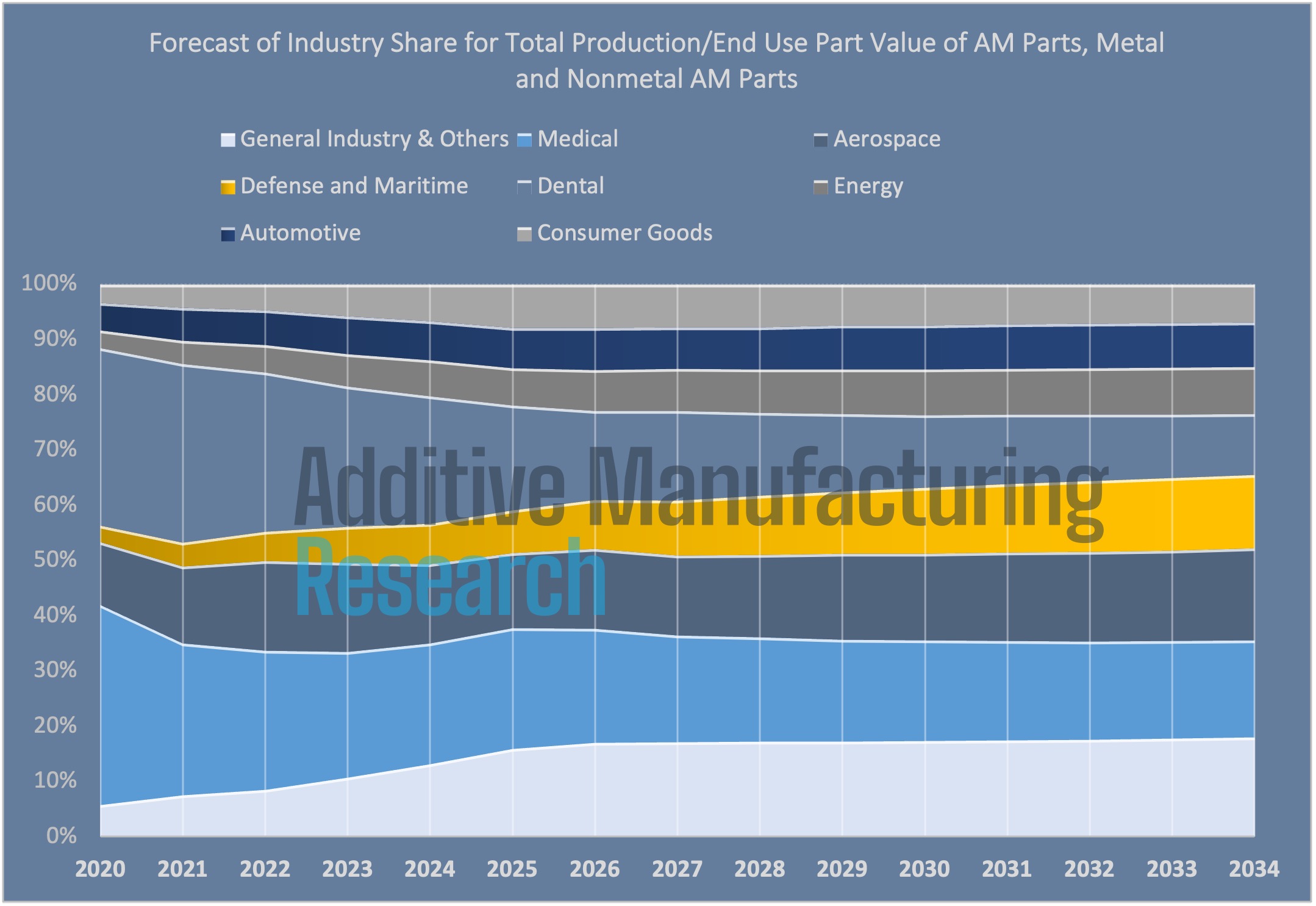
The report tracks additive manufacturing applications across eight major industries, including aerospace, healthcare, energy, automotive, defense, consumer goods, and general industrial applications.
The analysis combines written research with large data sets covering historical production volumes as well as projections through 2034. Separate data files track both metal and polymer parts, giving companies a detailed view of where additive manufacturing is gaining traction and where future opportunities may emerge.
AM Research notes that its analysis draws on more than a decade of market tracking within the additive manufacturing sector. Since 2013, the firm has produced industry reports used by manufacturers, investors, and other stakeholders to understand the evolving landscape of 3D printing technologies.
For years, 3D printing was mostly used for prototyping. But that’s starting to change. More and more companies are now using it to produce real parts.
There are still challenges around cost, scale, and certification, but the technology is finding new uses across industries. If current trends continue, 3D printing could play a much bigger role in manufacturing over the next decade.
Scott Dunham, the report’s author and Executive Vice President of Research at AMR, recently presented some of the findings at the Additive Manufacturing Strategies (AMS) conference in New York. He will also discuss broader market trends and new data during an upcoming AM Research webinar focused on 2025 industry results and what to expect in 2026.
Images courtesy of Additive Manufacturing Research
Subscribe to Our Email Newsletter
Stay up-to-date on all the latest news from the 3D printing industry and receive information and offers from third party vendors.
Upload your 3D Models and get them printed quickly and efficiently.