From Ukraine’s War Effort to U.S. Restrictions: The Debate Over Desktop 3D Printing – 3DPrint.com
 Varun
When I lifted the replica drone interceptor nosecone from the build plate of my Prusa Core One L, I noticed how precise and aerodynamic the part was. I admired the speed at which the extruder had created a part that would have taken my father, a master machinist, several days to produce on his lathes and milling machines. The process was familiar to me: a digital model, a spool of filament, and a printer making an object layer by layer. I printed this example to illustrate a manufacturing process that has taken on extraordinary significance in my grandmother’s home country of Ukraine, where civilian 3D printers and the people operating them have become part of the wartime supply effort; “Rosie the Riveter” with filament.
Ukraine’s resistance has drawn on resources far beyond conventional defense factories. Volunteer networks have used desktop consumer grade 3D printers to supply equipment to the front lines, bringing civilian tools and technical skills into a country’s response to an invasion. Their contribution reveals the strategic value of accessible building tools, or “Democratized Manufacturing,” in which production draws upon people and machines scattered across the borders of towns, cities, and countries. It also gives new weight to a debate unfolding in other parts of the world: how governments can restrict use of these tools if deemed dangerous, while simultaneously preserving the useful capabilities that make them worth having.
In a June 2024 Forbes article, journalist David Hambling interviewed “Eman,” identified as the founder of WildBees Poland. In the piece, Eman described several hundred volunteers 3D printing across more than 20 countries. Their slicers are populated with trench periscopes, drone recovery equipment, nose cones, thruster mounts, and detachable lightweight PLA wings.
“We are dispersed, but we can act completely independently of each other, like bees,” Eman told Forbes.
That observation illuminates something larger than the output of just one printer. The network brings people together who can contribute production capacity from different locations, with a myriad of different skill sets, rather than requiring everyone to work inside one facility.
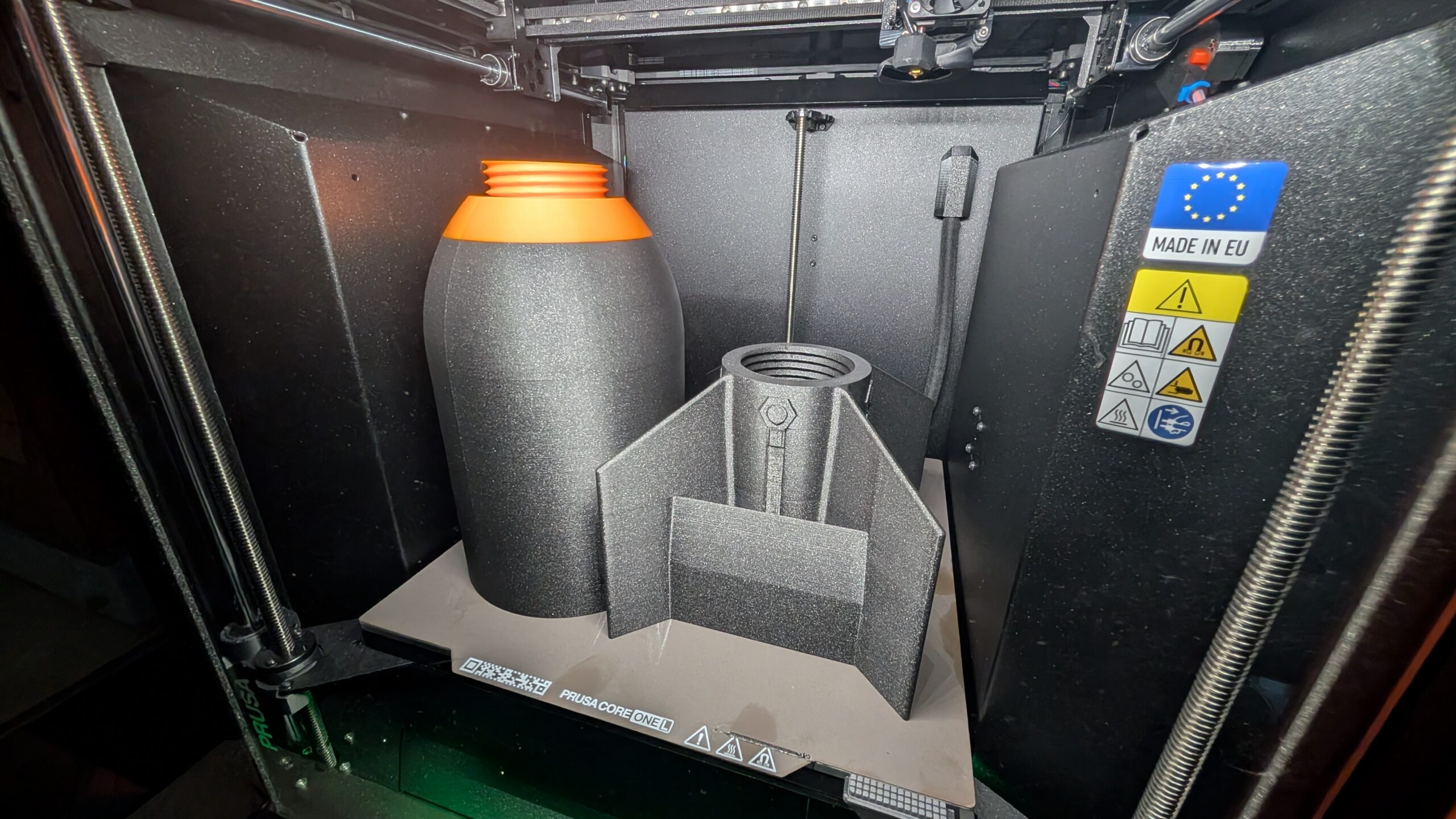
MakerWorld model: Bomb Airsoft prop 3 colors by Riccio
I was fascinated by Hambling’s reporting. The clear advantage to me was how designs could be revised instantly after feedback from users in the field, with new prototypes appearing overnight for iterative evaluation. For a mechanical engineer, that collective hive-mind evolution felt extremely familiar. Printers offer practical ways to move quickly between versions without creating dedicated tooling for every change, something companies like Prusa championed, and have been leveraging for years. This, though – this was new. On a battlefield, does a drone need a larger motor for a heavier sensor package? Now, any one of hundreds of volunteers could open up the Fusion 360 file, revise the digital model, and print another version for evaluation.
No molds. No tooling or dies. No lethargic, “glacial speed” engineering change orders.
But a finished plastic component is only part of a working system. Materials, quality, electronics, and delivery will always matter. The value, I was starting to see, lay in matching the process to a genuine need – and connecting the actual people making parts with the people who need them.
That struck me hardest. It’s the people operating these machines, the machines I’m using to make articulated dragons and Benchies – it’s those people that matter as much as the machines themselves. So much so, the Pentagon’s National Defense Industry Strategy (NDIS) identifies workforce readiness and defense essential industrial skills as priorities for America.
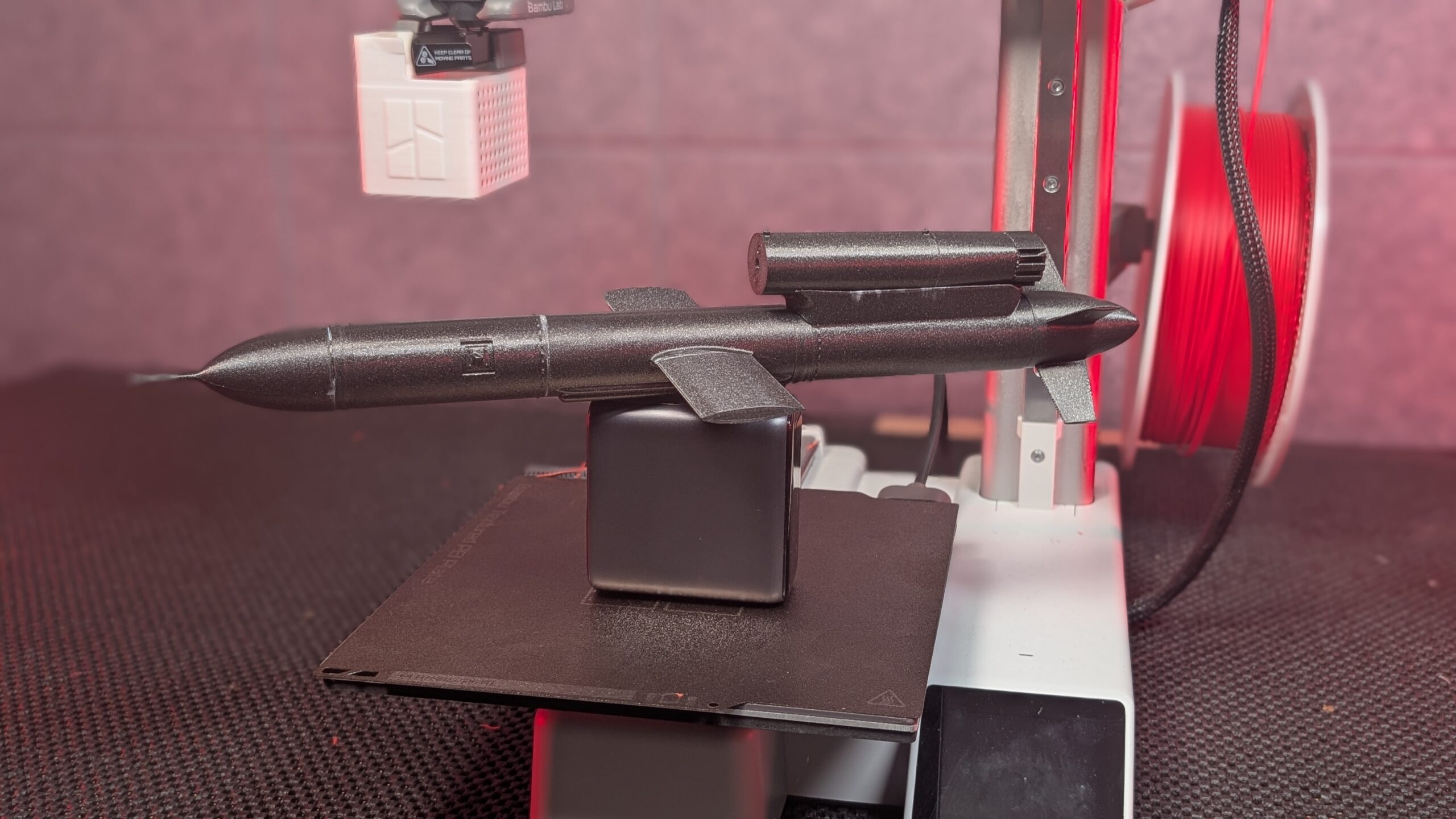
MakerWorld model: FP 5 FLAMINGO | Scale 1:35
Cody Wilson, founder of Defense Distributed, argues that restrictions on manufacturing tools and technical information could undermine those workforce goals. An advocate for access to digital firearm designs, he sees conflicting priorities in federal encouragement of manufacturing skills and state efforts to prevent illegal gun production.
New York and California enacted printer-blocking laws in 2026, but implementation remains conditional. New York’s sales requirement begins one year after implementing rules are issued, with rule-making dependent on technical feasibility. Its scope includes 3D printers, as well as digitally controlled subtractive machines like CNC mills. California’s AB 2047 ties implementation to feasible ASTM standards, with sales restrictions beginning one year after state guidance or regulations are published. “Feasible” is a nebulous word at the moment, with wording in the laws requiring 3D printer companies to supply hardware and firmware sold there to block firearm-related parts at the machine level, with AI and software filters that, as of yet, don’t exist.
Critics like Wilson are quick to point out the inevitable ‘cat and mouse’ loops these attempts to block files present. He’s released his own firearms manufacturing AI named “Gat-GPT,” trained on the thousands of firearms files in their online repository. Such an AI would bypass firmware and machine filters entirely, producing a theoretically infinite number of variations of weapons with accompanying bills of materials for commonly available hardware like springs and screws.
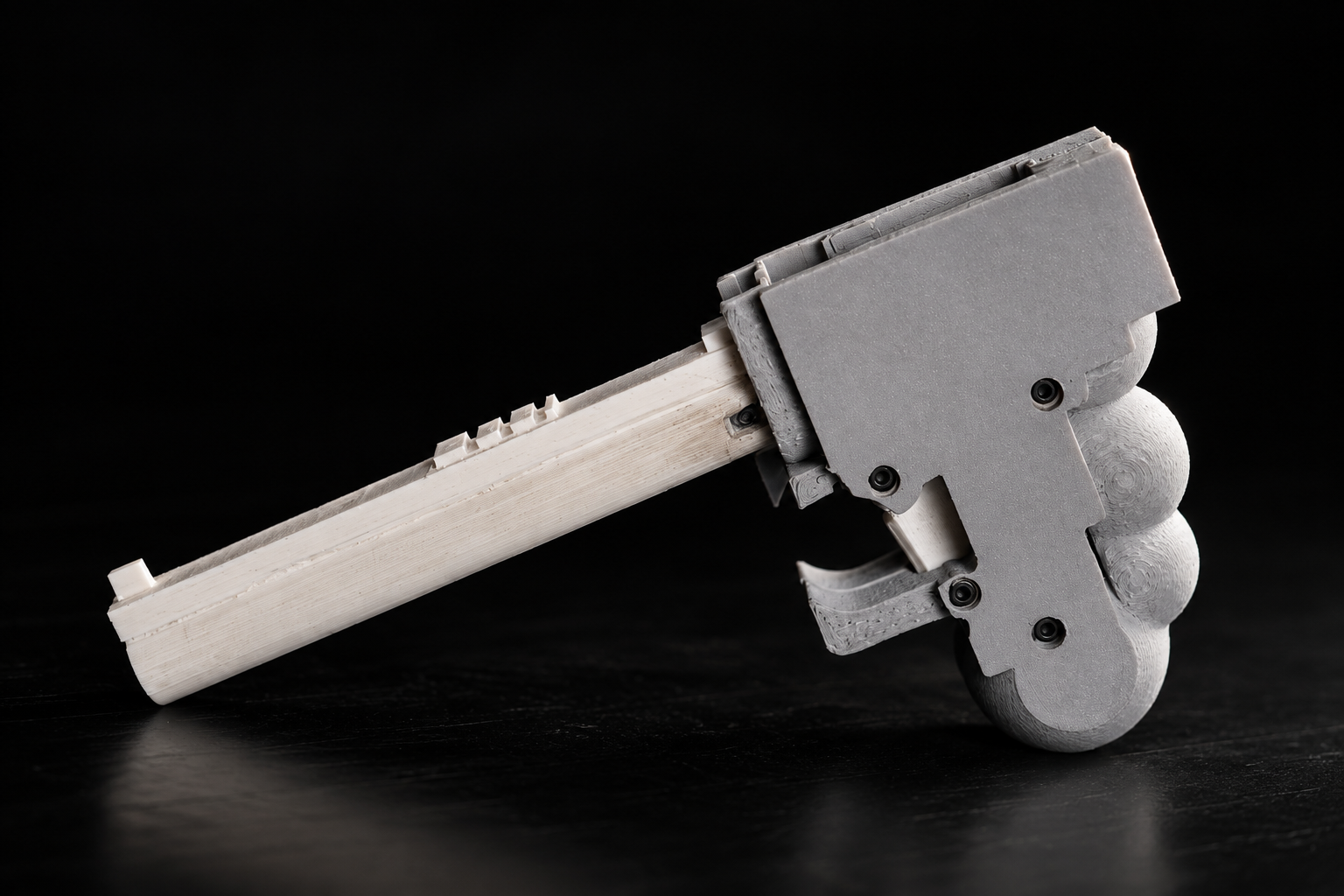
AI-generated “Gat-GPT” design. Image: Defense Distributed
Supporters of the measures say their aim is to curb illegal firearms, including unserialized “ghost guns” that complicate tracing and detection. Their approach to target production equipment as another means of preventing gun violence opens new and untested legal questions.
Is G-code First Amendment-protected free speech?
Can states like California sue a company like Polymaker, because their filament is a “precursor” to a ghost gun?
Who decides what a “precursor” is?
What is the legal status of the thousands of 3D printers already present in California and New York classrooms and STEM programs?
Wilson characterizes the Pentagon’s message, in light of the new laws, this way: “Here’s an irony, right? Where the DOD tells us, ‘Actually, it’s a liability that not enough citizens are out there learning the machine tool industry and how to build with defense industrial techniques and learn that science,’” noting that at the state level, the same equipment in contrast is being vilified and legislated by elected officials who don’t truly understand how 3D printers, or the G-code that drives them, actually work.
His concern is that restricting the tools could also restrict opportunities to learn. For ordinary users, file screening raises questions about mistakenly blocked replacement parts or classroom projects, while compliance costs could drastically affect printer prices and availability. These are potential effects, not established outcomes.
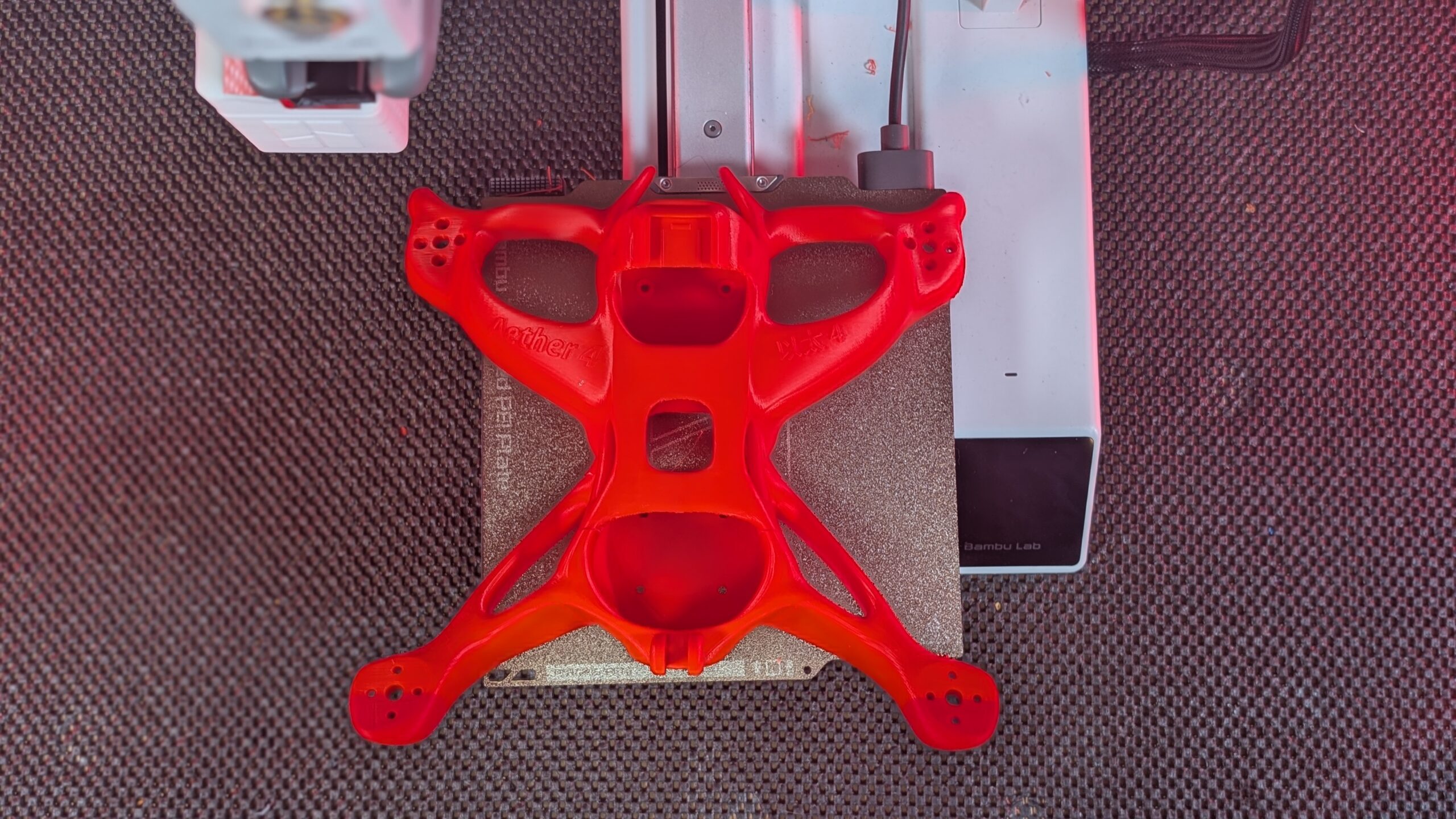
MakerWorld model: BM Aether 4 XL – The 5 – 6 inch FPV drone frame
When I asked him what his strategy was to combat this, Wilson said he has been arguing in federal courtrooms to create precedents that define the differences between information and fabrication. That is his legal argument, not a settled exemption for firearm design files.
Ukraine’s real world experiences offer a reason to stop and carefully examine the distinction. Access to manufacturing by civilians can serve purposes of public importance. How a restriction identifies prohibited production, and what legitimate work it might affect, requires closer scrutiny at a time when there is arguably a manufacturing renaissance exploding in the United States. The challenge is to prevent illegal weapons production while preserving legitimate learning, design sharing, and fabrication.
Back on my desk, the replica nosecone and fully functional drone frame bear the same layer lines as countless ordinary prints. What changes the meaning of those lines is the context, and what the people downstream are doing with the parts. Ukraine’s volunteer networks have brought attention to additive manufacturing capacity spread across homes and workshops. When we consider the future of desktop printing, those people, their skills, and their ability to contribute belong in the picture.
About the Author:
Michael Lydick | Mechanical Engineer & Technology Journalist
I’m a mechanical engineer, inventor, and technology journalist with more than 30 years of experience in industrial automation, manufacturing, and design. I’ve spent over 15 years exploring 3D printing, from FDM and SLA technologies to professional additive manufacturing systems.
I’ve worked as a freelance technology writer and reviewer for over a decade, contributing feature articles and hands-on product reviews to major publications, as well as creating content for my personal channel, “Hey, It’s Me, Michael,” where I focus on building things, testing them, and taking them on adventures to cool places.
My goal is to help people see 3D printing as more than a hobby or a machine that makes objects. It’s a practical tool that can become part of their everyday lives, helping them solve problems, bring ideas to life, and accomplish things they might not have thought possible.
Inspired early on by Jim Henson’s groundbreaking Creature Shop, I’ve always been fascinated by how creativity and technical innovation can bring entirely new worlds to life. Whether designing, building, or writing, I’m driven by one question: “What’s possible when imagination meets engineering?”
Images courtesy of the author, unless otherwise noted
Subscribe to Our Email Newsletter
Stay up-to-date on all the latest news from the 3D printing industry and receive information and offers from third party vendors.
Upload your 3D Models and get them printed quickly and efficiently.