Divergent Declares that German 3D Printers are Superior, And Plans Massive LPBF Expansion – 3DPrint.com
 Varun
Varun
Divergent has announced a new version of its Laser Powder Bed Fusion (LPBF) printer and a new site. The company aims to do nothing short of “further accelerating its mission to build the new industrial age.” It also says that it has “built the most advanced industrial metal 3D printer in the United States.” This implies that German and Chinese 3D printers are more advanced than American ones. This is quite an admission by the firm; after all, if it really thought it had built a better machine than EOS and BLT, it would have said it had made the world’s most advanced 3D printer. But this is sure to be welcome news to the Krailling crowd. However, I’m not sure if this implies that Divergent thinks that it has made a more advanced 3D printer than the Nikon SLM Solutions NXG. Or at least those units made in the US.
Divergent has always excelled at marketing, partnerships, and PR. The 3D printing market, always curious about Divergent’s prospects, is now wondering what the firm is doing with its over $1.1 billion in investments. After developing large-scale glue robots, the firm then diverged to an LPBF machine. It diverged, developing a design and manufacturing service to help companies produce AM parts. High-profile partnerships followed, diverging it further from making a car.
What is it doing to provide itself with new capabilities that others do not have? What can it do that an Incodema or Sintavia can’t? What’s the difference between Divergent’s offering and what a service does? What exactly is Divergent? Is it a late-out-of-the-gate unicorn designed to disappear, like a cohort of other firms? Perhaps there is a kind of duality between those entrepreneurs who can get money and those who excel at shipping products? Or will Divergent be able to make good on its promises to “build the new industrial age?” And why does it keep claiming to be the world’s first end-to-end software-hardware production system for industrial digital manufacturing? Clearly, Materialise had this decades ago, and lots of services have this now. What does that claim even mean? Does the Oak Ridge National Laboratory (ORNL) not have any software hardware production systems more advanced than Divergent? Has no one at ORNL or elsewhere ever built such a system? I’m done with mollycoddling everyone; it’s just not a good strategy for promoting the common good. It’s time to put up or shut up.

The Monolith One.
The company says its printer will have an output eight times higher. The system, called Monolith One, has 24kW and a build volume of 700 x 700 x 835 mm, while measuring 6.5 x 6.5 x 8.2 m.
Large-Format Metal LPBF Systems Comparison
| Manufacturer & Machine Model [1, 2, 3, 4, 5] | Build Volume (X × Y × Z mm) | Build Volume (Liters)* | Laser Array Configuration | Individual Laser Power | Total Cumulative Laser Power (kW) | Size Status vs. 700×700×835mm |
|---|---|---|---|---|---|---|
| Eplus3D EP-M3050 | 3058 × 3058 × 1200 | 11,239.5 L | Custom Multi-Laser Array | 500 W / 1000 W | Up to 64.0 kW | 27.47× LARGER |
| Eplus3D EP-M2050 | 2058 × 2058 × 1100 | 4,658.9 L | Custom Multi-Laser Array | 500 W / 1000 W | Up to 64.0 kW | 11.39× LARGER |
| AddUp “MASSIF” Project | 1500 × 1500 × 2000 | 4,500.0 L | Custom Multi-Laser Array | 500 W / 1000 W | Variable | 11.00× LARGER |
| Farsoon FS1521M-U (Tall) | 1530 × 1530 × 1650 | 3,862.5 L | 16 or 32 Fiber Lasers | 500 W | 8.0 kW or 16.0 kW | 9.44× LARGER |
| BLT BLT-S1500 (Max Z) | 1500 × 1500 × 1500 | 3,375.0 L | 18 or 26 Fiber Lasers | 500 W | 9.0 kW or 13.0 kW | 8.25× LARGER |
| Eplus3D EP-M1550 | 1558 × 1558 × 1200 | 2,912.8 L | 16 or 25 Fiber Lasers | 500 W (1kW optional) | 8.0 kW to 25.0 kW | 7.12× LARGER |
| BLT BLT-S1500 (Base) | 1500 × 1500 × 1200 | 2,700.0 L | 18 or 26 Fiber Lasers | 500 W | 9.0 kW or 13.0 kW | 6.60× LARGER |
| Eplus3D EP-M1250 | 1250 × 1250 × 1350 | 2,109.4 L | 9 to 16 Fiber Lasers | 500 W (1kW optional) | 4.5 kW to 16.0 kW | 5.16× LARGER |
| Farsoon FS1521M (Standard) | 1530 × 1530 × 850 | 1,989.8 L | 16 or 32 Fiber Lasers | 500 W | 8.0 kW or 16.0 kW | 4.86× LARGER |
| BLT BLT-S1000 | 1200 × 600 × 1500 | 1,080.0 L | Up to 12 Fiber Lasers | 500 W | 6.0 kW | 2.64× LARGER |
| AMCM (EOS) M 10K | 1000 × 1000 × 1000 | ~1,000.0 L | Multi-laser Custom Array | 1000 W (1 kW) | Variable | 2.44× LARGER |
| Nikon SLM NXG XII 600E | 600 × 600 × 1500 | 540.0 L | 12 Fiber Lasers | 1000 W (1 kW) | 12.0 kW | 1.32× LARGER |
| AMCM (EOS) [M 8K] | 800 × 800 × 1200 | 768.0 L | 8 Fiber Lasers | 1000 W (1 kW) | 8.0 kW | 1.87× LARGER |
| Eplus3D EP-M825 | 825 × 825 × 1100 | 748.7 L | 8 Fiber Lasers | 500 W | 4.0 kW | 1.83× LARGER |
| Monolith | 700 × 700 × 835 | 409.2 L | 12 | 2 Kw | 24 kW | — |
| Velo3D Sapphire XC 1MZ | Ø 600 × 1000 (Cyl) | 282.7 L | 8 Fiber Lasers | 1000 W (1 kW) | 8.0 kW | 31% Smaller |
| Nikon SLM NXG XII 600 | 600 × 600 × 600 | 216.0 L | 12 Fiber Lasers | 1000 W (1 kW) | 12.0 kW | 47% Smaller |
| EOS [M4 ONYX](1.3.3, 1.3.6) | 450 × 450 × 400 | 81.0 L | 6 Fiber Lasers | 400 W | 2.4 kW | 80% Smaller |
| Nikon SLM SLM 500 | 500 × 280 × 365 | 51.1 L | 4 Fiber Lasers | 400 W / 700 W | 1.6 kW to 2.8 kW | 87% Smaller |
The 12-laser system will have 2 kW lasers and work with aluminum, nickel, steel, and titanium. The system was developed in-house across 28 months. The company also, rather interestingly, says that the Monolith One can produce “multi-material structures.” That is very interesting, and I’m very curious. Do they have the Aerosint multiple recoater technology, or how are they doing this? This could be a real advantage in some aerospace and armor structures. Especially if it could build these efficiently without too much change around. The Monolith One is entirely made in the USA. The company also implies that all components come from there. This should be a great relief to defense users. But, you are not allowed to buy one.

The Monolith One.
The company is also expanding to a 430,000 sq.ft facility in Long Beach. There are six Monoliths running, which implies that they’re at around a tenth of the capacity of several other firms in the Long Beach area. What is very exciting is that the company aims to install 64 more machines over the next two years. That would make them one of the largest operators of LPBF machines in Long Beach. Their total capacity over two years will therefore be approximately 10% of BLT’s current capacity.
“The Monolith One is the first metal 3D printer designed ground up for scaled production of critical hardware. Importantly, its design encompasses the years of operational insights we have earned delivering production structures to the defense and commercial sectors. Monolith One is an American machine with an American supply chain. We are building them at rate today and our Long Beach factory will house 64 more of them. With annual output in the tens of thousands of munitions airframes or hundreds of thousands of critical piece parts, our second factory represents the new industrial age at scale.”

Divergent Factory in Long Beach.
The company hopes to work in defense and use “4-axis scanners with spot-size zoom capability” to improve throughput. Divergent also says that a 1700 cm2/min gas-flow unit allows for fewer optical window washes and longer print runs. Powder handling is closed-loop. The company has worked on build plates, with “heating and novel cooling controls up to 200°C to enhance reliability, dimensional stability, and repeatability.” It has optimized turnaround times through software and interchangeable build volumes. We can’t be sure whether it’s kind of like a Farsoon continuous-build thing or if it works differently.
Divergent’s CTO Brian Erhartic,
“Every feature of Monolith One was engineered to maximize reliability, scalability and control,By starting from a clean sheet, our team has built an additive manufacturing solution that expands the overall performance envelope of DAPS, particularly to serve a wider customer landscape and drive efficiency into downstream operations. It’s only because we custom engineered the printer specifically for integration into DAPS, that we were able to realize a significant increase in operational efficiency, quality control, and build volume.”
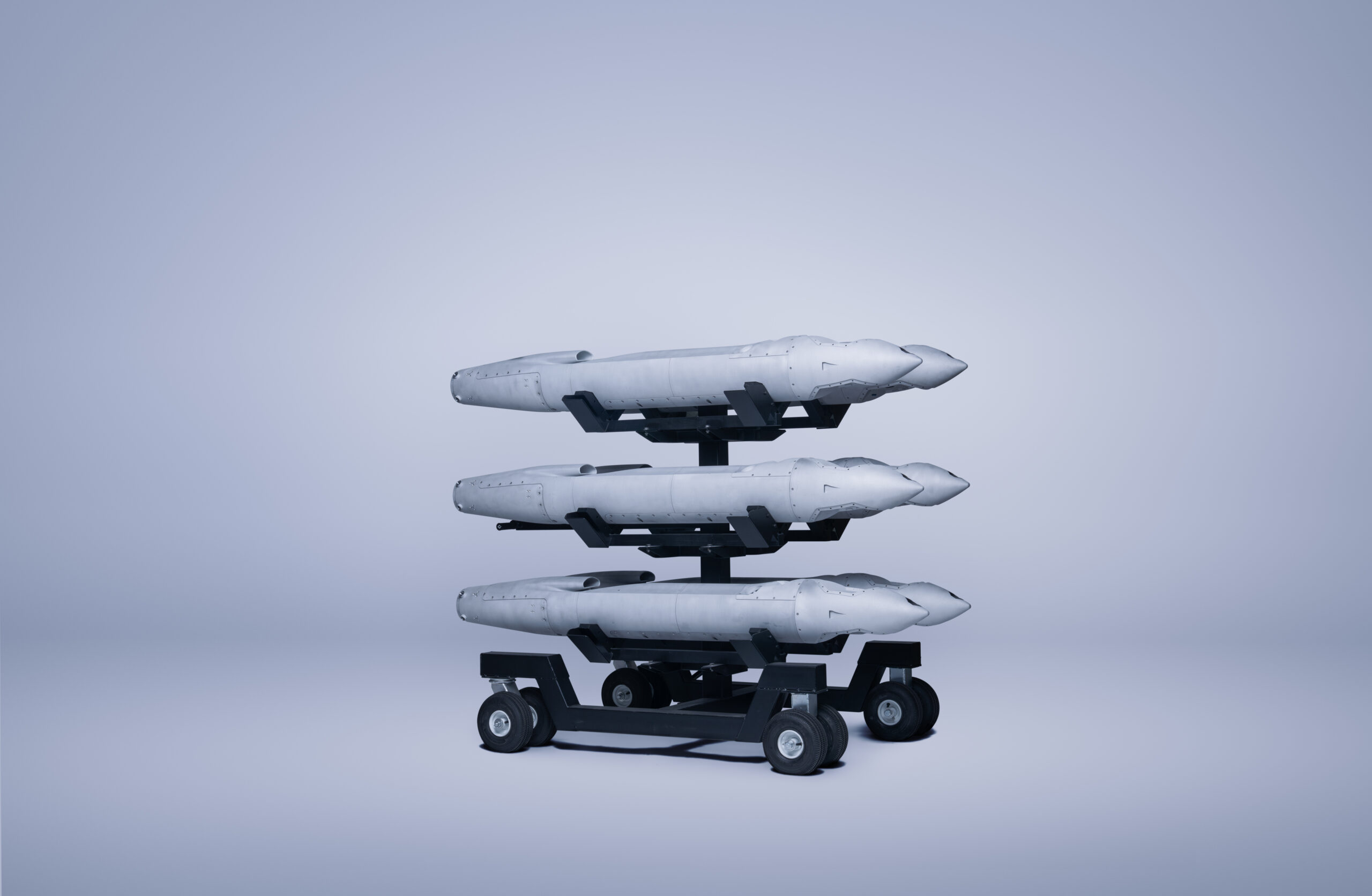
Cruise missiles for CoAspire.
The company hopes that with the new printers in place, in two years it can make (either/or): over 30,000 missile airframes, 60,000+ warhead casings (100lb class), 25,000+ automotive subframes, or 30,000+ automotive suspension systems. I’m not sure if it’s economical to run parts like that in LPBF. But perhaps the firm can really lower costs significantly.
-

- Front upright for McLaren.

-
- Front cross brace for Bugatti.

Divergent states that it is valued at $2.3 billion and has raised over $1 billion, while it has impressive clients such as “CoAspire, Saab, Triumph Group, Bugatti, and McLaren.” The in-house 3D printing approach, using a software-enhanced large-format LPBF process coupled with design and sensor integration, seems promising. Indeed, Seurat, VulcanForms, and others are trying it as well. Doing this at a time when the US needs to rearm and make complex parts quickly is auspicious. The firm is also ambitious, and good at socializing and spreading its mission.
But we’ve lived in a land of claims for far too long. I want to see Divergent succeed. I want to see those tens of thousands of parts coming out of there. But I want to see parts; I want to see volume. I’m done riding shotgun on other people’s dreams; I’m done being led to la-la land by unicorns. It’s put-up-or-shut-up time. I want to see parts. I want to compare parts and know how much is being made. It’s time to get real.
Images courtesy of Divergent
Subscribe to Our Email Newsletter
Stay up-to-date on all the latest news from the 3D printing industry and receive information and offers from third party vendors.
Upload your 3D Models and get them printed quickly and efficiently.