Australian Researchers Develop Accelerator-Free Underwater 3D Concrete Printing System – 3DPrint.com
 Varun
Varun
Infrastructure projects are just as important as housing to the additive construction (AC) market segment, and structures used for underwater applications like coastal resilience have steadily become one of the most popular use-cases amongst the growing number of AC-for-infrastructure projects emerging in the last few years. The most recently announced examples in this sub-surface construction category signal that, soon enough, AC users will no longer be content to build off-site: they’ll print their projects directly under the water.
Last week, Sarah Saunders wrote about a DARPA-backed project at Cornell University involving the development of an underwater building material “made [primarily] of seafloor sediment.” Additionally, the Australian AC enterprise LUYTEN 3D has announced that, in collaboration with the University of Wollongong (UOW), the company has created the first accelerator-free concrete mix specifically designed for underwater prints.
Concrete accelerator is typically used in conventional construction processes to speed up the hardening process during winter, as well as in underwater builds, to prevent concrete from washing away. The LUYTEN 3D/UOW formula, by removing the need for accelerant, both simplifies the printing process and, according to LUYTEN 3D, enhances its overall sustainability.
As with the Cornell University project, LUYTEN 3D has tested the process so far in a lab setting, using saltwater and seabed sand to closely mimic real-world conditions. According to LUYTEN 3D, in addition to coastal resilience and ecological restoration, the company views offshore wind energy and even defense as target markets for the submerged printing technique.
In a press release about LUYTEN 3D’s collaboration with the University of Wollongong on an accelerator-free concrete mix engineered for submerged AC projects, Senior Professor Gursel Alici, Executive Dean of the Faculty of Engineering and Information Sciences at UOW, said, “The successful demonstration is a testament to the high calibre of our engineering talent and world-class laboratories. Our team has solved a complex material science problem, eliminating chemical accelerators without sacrificing stability, showing the depth of expertise within the School of Engineering.”
Ahmed Mahil, CEO and Global President of LUYTEN 3D, added, “Printing underwater fundamentally changes how we think about building, repairing and strengthening critical infrastructure in marine environments. This is a completely new chapter for construction and manufacturing.”
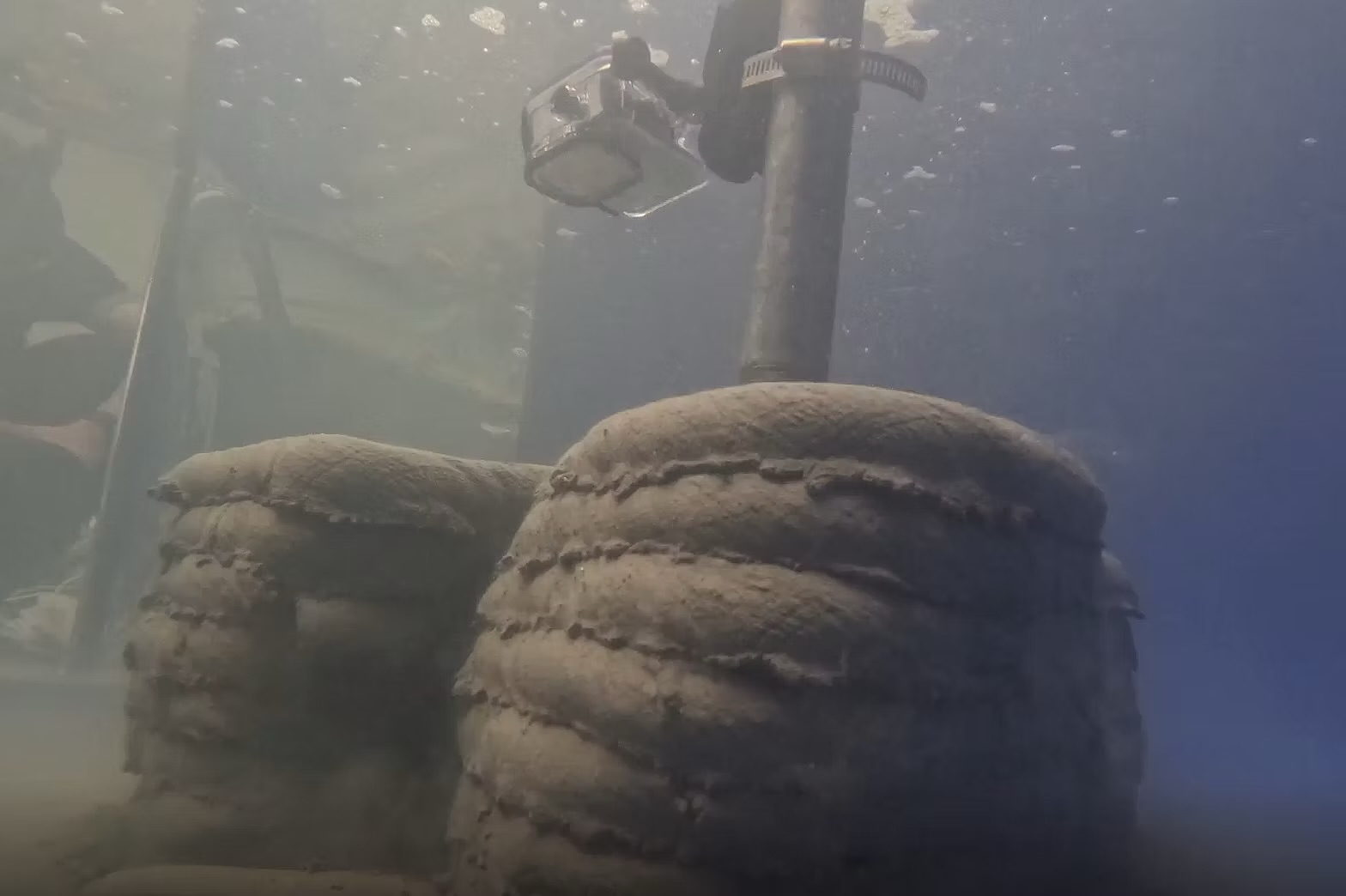
Underwater 3D concrete printing without accelerators.
While there’s no telling how quickly these products from Cornell and LUYTEN 3D/UOW will actually scale up into commercial realities, I don’t think anyone should ignore the demand signals at play here. The fact that these R&D projects are underway, if nothing else, indicates how strong a driver underwater infrastructure is for increased AC adoption.
Further, if the material science gains reflected in this pair of projects can indeed make submerged construction 3D printing a simpler process, then that should, simultaneously, go a long way towards accelerating the commercialization prospects for the new material approaches. Submerged AC and the new material formulations could combine to yield a flywheel effect.
While the processes obviously have nothing to do with one another, it’s interesting that the ideas present in LUYTEN 3D’s work reflect similar themes to what Perseus Materials is doing with its composite AM tech. In both cases, simplified additive techniques deployable on-site are gaining traction for applications at the intersection of energy and security.
This is, in my view, the most appropriate role for AM and AC alike as they become more routine fixtures within global supply chains. If the 3D printing industry can demonstrate that it’s equipped to step up to the plate in delivering power utility resilience, the industry could be structurally re-rated by the market from a niche fabrication technology to critical public infrastructure.
Images courtesy of LUYTEN 3D/UOW
Subscribe to Our Email Newsletter
Stay up-to-date on all the latest news from the 3D printing industry and receive information and offers from third party vendors.
Upload your 3D Models and get them printed quickly and efficiently.